
Magical realism is a interesting genre. It is defined by it’s magical elements and occurrences, but not set in a magical world. Used to convey and express characteristics of the country and characters. I have read magical realism books from various countries and they all approach this genre differently. The changes vary to the history and culture of that country. I have not read many from this genre from the Caribbean so I am very interested to see how this genre helps me understand and experience the islands in a new way.
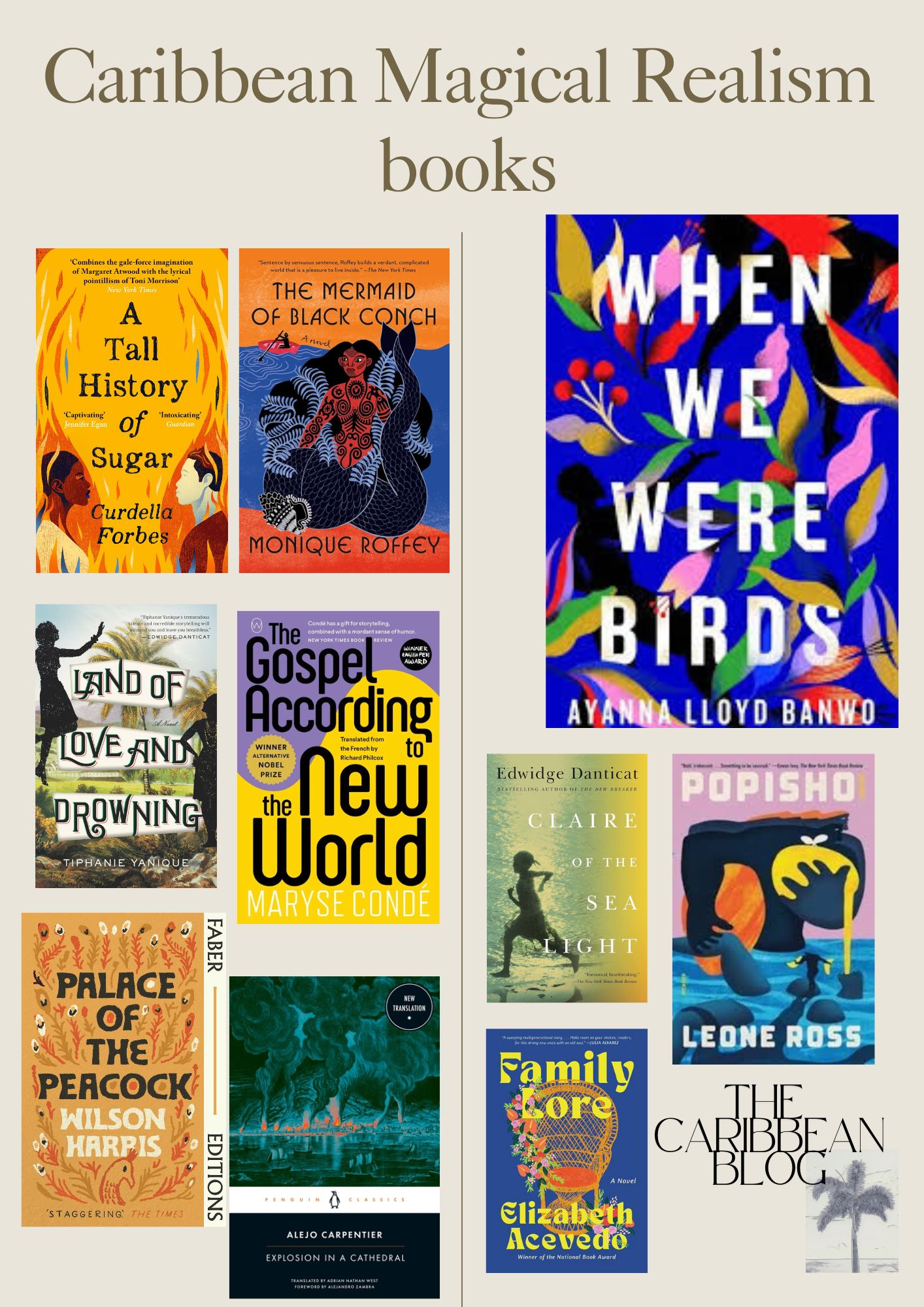
When we were birds by Ayanna Lloyd Banwo
From the first page I was immediately swept away with the lush world and writing. Set in Trinidad, starting with Yejide on Granny Catherine lap. Sharing the story of the beginning of life as natural, powerful, and full of animal life. The human intrusion and greed being the downfall of these mystical beings.
But one day a warrior wander into the forest. He see that it full of animals to hunt and fruit to eat. When he look at the trees he only see the house he could build; and when he look at the land he only see what he could take – 3pg
This was the first of many quotes that intrigued me and instantly connects me to the history of the Caribbean shared on a lap. The legacy of taking and extracting from the island, and how this shifts everything forever. A magical story used to link with the real history of the Caribbean, but saying more by using magic. Expressing the wonder and mystery surrounding Caribbean history and lore. Then we shift to present day Port Angeles, Trinidad. Following Darwin, a rastaman facing unemployment, having to pick between his upbringing and a last resort job. Working in a graveyard which is completely against his upbringing and morals of not seeing the dead. We follow Darwin living a life against his values, cutting his hair, and the dealing with the clash of city life. The other main character of this story is Yejide, her Granny passes away and her world cracks open. Revealing the world she has been part of but not fully until her Granny passes away. Her relations with death and the dead pushes her to face her new reality. I don’t want to give away the main reveals and plots because it was fantastic how the author weaves the two contrasting characters together; as one who is taught to be afraid of death, and the other who lives with death.
The striking element I took from this book was the realness of the characters struggles and experiences. The depiction of what you have to give up to get a job in the city, and what you have to do to survive the modern times. The challenge of how far are you willing to go to provide and survive for yourself and family. A key theme from this story was that even if you do something outside of your moral compass to survive, the legacy of your family and the individual does not have to disappear. Your ancestors and history can help you stand against other challenges. Yejide also learns this lesson in a more magical way as she learns that her history and ancestors live with her daily interactions with the dead.
This book was a love letter to the stories shared within family of the land and your ancestors. The magical elements added to that fantastical feeling of sharing stories. The Caribbean features strongly in the magical aspects of the story as a way to express loss, death, the legacy of upheaval at a large scale that is unique to the island. These themes are important to the Caribbean’s peoples, history, and legacy. Using magical realism creates a more emotive story to convey what it feels like to be apart of the Caribbean.
A Tall history of sugar by Curdella Forbes
From the first page this felt like a Caribbean story that captures the wit and history of the people. Following a couple who are at their breaking point trying to start a family. The woman, Rachel, stumbles on a baby near by the hospital. This child is not your usual person; he has see-through skin. When this boy, Moshe, goes to school he meets a girl, Arii, who is unusual too, being very tall and deep skinned. Instantly forming a bond beyond words. This book follows their journey growing up, navigating being friends and then lovers. How their contrasting elements was all part of the plan of their destiny to be together. The most interesting theme of this book was sugar. The legacy of sugar, the impact of sugar on the locals health and lifestyle, and how our main character was deathly allergic to sugar. This is interesting because the title of the book highlights the long legacy of sugar in Jamaica, but our main character body and nature rejects it. Moshes’ body and nature used by the author to be beyond that legacy and oppression by rejecting sugar. This is an important feature as Moshes’ beginnings are rooted in the legacy of Jamaica including brutality against Black people and bodies.
And yet the matter of sore and blood that bound father and son together was somewhat of a contradiction, for the surfeit of sugar that had given Noah his sore was the exact opposite of Moshe’s affliction. The child was born allergic to sugar and could not eat it. Between the father’s overconsumption and indigestion, and the child’s abstention, the two were as different as two people could be who had grown up in the same place under the same sun under the same dominion of sugar – 55pg
This quote embodies the conflicting reactions to sugar in the same environment which is apparent through out the story. This represents the conflicting stories and legacy of sugar in Jamaica, the Caribbean, and the world. How present sugar is in our diets, the origin of sugar plantations, and the brutality surrounding sugar is expressed by the author using the story of Moshe. The magical elements of this story expresses the extraordinary reality of living in Jamaica. The tales, history, and community is a key feature. We then follow Moshe as a young man navigating education, leaving home, and moving to England. The difference and similarities shared with the “motherland” was interesting. As his appearance and magical skin create interesting interactions with being othered, and people struggling to place him into a category. The author explored the self of Moshe outside of the Caribbean setting, going to England, and exploring who Moshe is outside of his home and environment.
This book felt more like the traditional magical realism of One hundred years of solitude by Gabriel Garcia Marquez where it is following main characters, but the wider history (colonisation) and family history are pushing and pulling the characters into their destiny and story. I see that type of story telling in this book.
Wider reflections
dysphoric struggle with identity as a result of
colonization. This thematic unity can be observed
in the use of magical realism, a writing technique
that juxtaposes fantastical elements with the harsh
realities of life – 24pg
Magical realism is used to discuss and explore the legacy of colonisation and generational trauma. Using magic and mythology to discuss this history and how it influences the peoples of the Caribbean. Either by having magical abilities, a unexplained magical characteristic, or the island lush with power and magic. They are all rooted in a harsh history of colonialism and slavery. In a way that this is the lands and the people response to brutality, and exploitation. The author’s intent is to show the power of the land and people in the extraordinary way of surviving and thriving against the backdrop of colonialization and slavery. Weaving in Indigenous and African mythology into their stories because that is the grounds of the Caribbean which cannot be ignored and is present in the majority of Caribbean literature. The two authors I have read for this article use magical realism to approach the legacy of colonisation as the foundation of the magic of the islands. The trauma, and history of the people and our main characters are a reflection of the powers of surviving and thriving with the land. Moshes’ existence born from the brutality of colonisation and post-enslavement. His being is the reflection of magic and power to exist beyond that history. Magical realism allows authors to explore that legacy and the strength of the people.
A key point made by Stephen Slemon that magical realism deals with the collision of two worlds that exist in the same place and are very different from one another. These worlds are constantly in conversation with each other. This
genre is a unique post-colonisation genre that reflects reality of a double-vision that exists within colonial culture. In each book explored in this article the two realities of Western colonisation/society is colliding with the people’s culture and existence. Like the two worlds of having to find a job to survive and moving to the city verses the dead very much part of the island and your daily decisions. Very different perspectives of life but existing along side one another in the same city. This reflects the wider Western ideals existing alongside the Afro-Caribbean culture and society. Both of these books explore that system of two worlds on the same island.
Text referred to:
- When we were birds – Ayanna Lloyd Banwo
- A Tall history of sugar – Curdella Forbes
- Magic and Identity in Anglophone and Hispanaphone Caribbean
Literature – Kayley Salgado (2022) - Magical realism as post-colonial discourse – Stephen Slemon (book chapter) 1995



Leave a Reply